In the twilight of the Qin Dynasty, in ancient China, there stood a vast workshop near the city of Xi’an, bustling with activity. The year was 210 BC, and the First Emperor of China, Qin Shi Huang, reigned over a unified land. At the heart of the empire, an ambitious and monumental project was underway—a testament to the Emperor’s power and his vision for the afterlife.
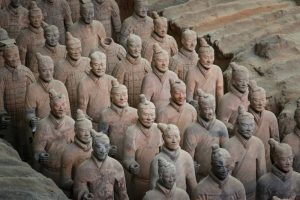
Among the craftsmen and laborers working diligently in the workshop was Li Wei, a seasoned sergeant from the Emperor’s elite cavalry unit.
Li Wei, respected for his exceptional archery skills and unwavering loyalty, found himself chosen for a remarkable honor. He was selected to be the model for one of the terracotta soldiers that would comprise the legendary Terracotta Army. The Emperor’s mausoleum, an awe-inspiring complex hidden beneath the earth, was to be guarded by this magnificent army in the afterlife, a reflection of Qin Shi Huang’s desire for eternal protection and glory.
Li Wei stood tall, proud, and resolute as artisans meticulously crafted his likeness. Most of the soldiers in the vast terracotta army were made of standardized parts, but a few important people of special renown were chosen for special attention.
Skilled sculptors and craftsmen, employing ancient techniques and meticulously-crafted molds, carefully shaped his figure. His face, weathered by years of battle, was immortalized in clay, capturing the essence of a seasoned warrior. Each detail of his armor, from the intricately engraved chestplate to the sturdy leather boots, was recreated with painstaking precision. His bow, a symbol of his archery prowess, was elegantly poised in his hands, ready for battle even in the afterlife.
Wooden beams formed a protective canopy above the trenches where Li Wei’s statue was positioned with its fellows. The air in the workshop was thick with the scent of clay and wood, and the sounds of chisels and hammers filled the air. As Li Wei stood for the sculptors, he marveled at the rows upon rows of terracotta soldiers, each with their unique expressions and postures, all brought to life by the skilled hands of the craftsmen.
Li Wei’s purpose in this grand endeavor was clear—to stand guard in the Emperor’s eternal army, a sentinel against any threats that might arise in the afterlife. His likeness, frozen in time, would serve as a reminder of his dedication and loyalty to the Emperor and the empire. The significance of this task was not lost on him; he knew that he was part of something far greater than himself.
As the construction of the Terracotta Army continued, Li Wei pondered the legacy they were creating. He envisioned future generations marveling at the craftsmanship, standing in awe of the silent army that bore witness to the might of the Qin Dynasty.
In the years that followed, the terracotta soldiers, including the one of Li Wei, stood silently beneath the earth, their significance lost to the sands of time. The roofs collapsed, the figures buried and often broken, and eventually all knowledge of the existence of the massive terracotta army was lost to time.
In 1974, local farmers near Xi’an, China, unearthed fragments of terracotta statues while digging a well. Recognizing the historical importance of their find, they reported it to authorities. Archaeologists swiftly arrived at the site, marking the beginning of extensive excavations that would uncover one of the most significant archaeological discoveries of the 20th century.
Careful excavation revealed three main pits, containing thousands of life-sized terracotta soldiers, horses, and chariots. The soldiers were positioned in military formation, showcasing the meticulous planning and craftsmanship of the Qin Dynasty. The discovery shed light on the grandeur of the ancient Chinese military and the vision of Emperor Qin Shi Huang, who unified China and commissioned the construction of this extraordinary army to accompany him in the afterlife.
Archaeologists painstakingly pieced together the fragments, reconstructing the soldiers and other artifacts with immense precision. Advanced techniques were employed to study the statues’ pigments and recreate the original colors, providing valuable insights into ancient Chinese artistry. The restoration process, carried out by skilled experts, aimed to preserve the authenticity and historical integrity of the terracotta army.
The site has since become a UNESCO World Heritage Site and a prominent tourist attraction. Visitors from around the world can explore the excavation pits, marvel at the terracotta soldiers, and gain a profound understanding of ancient Chinese history and culture. Museums and exhibition halls at the site provide in-depth information about the archaeological findings, detailing the historical context, the restoration process, and the significance of the terracotta army in the Qin Dynasty.
Ongoing archaeological work continues to uncover new insights, making the Terracotta Army site a living testament to the dedication of scholars and archaeologists in unraveling the mysteries of the past. The site stands as a remarkable window into ancient China’s military might, artistic achievements, and the enduring legacy of Emperor Qin Shi Huang.
As visitors approach the sprawling archaeological site, they are greeted by a sense of anticipation and wonder. Stepping onto the grounds, they find themselves immersed in an extraordinary journey through time.
In Pit 1, the largest and most impressive of the excavation sites, thousands of terracotta soldiers, horses, and chariots are meticulously arranged, each figure bearing the mark of ancient craftsmanship and dedication. The air is thick with the weight of history as visitors walk amidst the soldiers, marveling at the scale and precision of the army that once guarded an emperor’s tomb.
Adjacent museums and exhibition halls provide a deeper understanding of the Qin Dynasty’s legacy. Tourists find themselves surrounded by artifacts and detailed explanations, unraveling the story of the ancient empire and the discovery of the terracotta army. Interactive displays come to life, allowing visitors to virtually engage with the soldiers and the artisans who crafted them, bridging the gap between centuries.
In corners of the site, conservation workshops bustle with activity. Here, experts delicately restore fragments, preserving the soldiers for future generations. Visitors peer into this meticulous process, witnessing firsthand the dedication and care that go into maintaining the historical integrity of the artifacts.
Knowledgeable guides weave narratives, painting vivid pictures of Emperor Qin Shi Huang’s vision and the cultural significance of the terracotta army. Stories of ancient battles, architectural marvels, and the enduring spirit of craftsmanship come alive, immersing tourists in the rich tapestry of Chinese history.
Souvenir shops beckon with replicas and mementos, allowing visitors to take home a piece of the ancient wonder they’ve experienced. Meanwhile, the aroma of local cuisine wafts from nearby cafes, inviting tourists to savor the flavors of the region and reflect on their journey through time.
Leaving the site, tourists carry with them not only souvenirs but a profound sense of connection to the past. The terracotta army, once buried in the depths of history, has become a living testament to human ingenuity and perseverance. Visitors depart, their minds brimming with the stories of emperors and artisans, warriors and craftsmen, forever touched by the legacy of an ancient civilization.
Visitors can reach Xi’an easily through its major airport, Xi’an Xianyang International Airport (XIY), and explore a wealth of attractions beyond the renowned Terracotta Army site. These attractions include the ancient Xi’an City Wall, the iconic Big Wild Goose Pagoda, the vibrant Muslim Quarter with its street markets and delicious cuisine, the Shaanxi History Museum showcasing regional history, the historic Huaqing Palace with its hot spring site, and the breathtaking natural beauty of Mount Huashan. Xi’an offers a seamless blend of ancient heritage and modern charm, making it a must-visit destination for travelers.
We may never know which terracotta statue represents which soldier in the First Emperor’s army, but the sight of the figures of the terracotta army standing sentinel at the emperor’s tomb leaves an indelible impression. Each statue, once brought to life by ancient hands, now stands as a silent testament to the craftsmanship, dedication, and mystery of an extraordinary era.
Just as Li Wei’s likeness found its place somewhere among these stoic warriors, every visitor’s imagination finds a connection with the past in the solemn gaze of these ancient sentinels. Their presence evokes a profound sense of awe and curiosity, inviting us to contemplate the depths of history and the enduring legacy of the Qin Dynasty, leaving an enduring mark on the record of human heritage.
For more information
About the Author

Max Reynolds is well known for writing about East Asian cultures, renowned for captivating articles that transport readers to the enchanting landscapes and vibrant cities of Asia. With his help, you can always expect to uncover the hidden gems and cultural nuances of this captivating region.
Drawing from an extensive background in anthropology and history, Max's articles provide a rich tapestry of insights into the diverse societies, traditions, and historical contexts that shape East Asia. Meticulous research and unwavering attention to detail ensure that readers can rely on the accuracy and authenticity of his work.